Get On Up is a new biopic of James Brown, directed by Tate Taylor (The Help), and starring Chadwick Boseman (Jackie Robinson in laster year’s 42), Viola Davis, Octavia Spencer, Dan Aykroyd, and Craig Robinson.
The Screen Life
Film, TV, and the Internet

Author Archives: Alftuba
Double Double: Two New Films About Doppelgangers (Trailers)
There are two very different movies coming out this year with a very similar premise. That odd coincidence is even more striking when you consider what that premise is: doubles.
In The Double, Jesse Eisenberg’s life is turned upside-down when he discovers another person that looks and sounds exactly like himself. Directed by Richard Ayoade (Submarine), adapted from the Fyodor Dostoevsky novella of the same name.
In Enemy, Jake Gyllenhaal’s life is turned upside-down when he discovers another person that looks and sounds exactly like himself. Directed by Denis Villeneuve (Prisoners), adapted from the José Saramago novel “The Double.”
Sound similar? Both feature a young male movie star in a dual role. Both are directed by an indie filmmaker known for dark and stylized (though decidedly different) visions. And both are based on source material called “The Double.” I can’t find (with a 3-minute Google search) any evidence that Saramago’s book was based on Dostoevsky, though I find it hard to imagine there wasn’t at least some direct inspiration involved.
Either way, the films appear to be doubles of each other, in a way. Talk about “meta!” Check out the trailers back to back…
The Double (2014)
Enemy
(Enemy has actually already screened for some critics. Check out Guy Lodge’s review here.)
These are not to be confused with the 2011 films The Double or The Devil’s Double. Of course, it’s not all that surprising anymore to see two very similar movies released back to back. Here are just a few others that seemed to hit upon some unspoken zeitgeist at the same time:
- Capote and Infamous (2005) – Biopics of Truman Capote, specifically the period in which he researches and writes the book “In Cold Blood”
- The Illusionist and The Prestige (2006) – 19th century magicians elude those who would unmask their secrets.
- Happy Feet (2006) and Surf’s Up (2007) – Unlikely outcasts compete for glory in skills that one wouldn’t normally associate with animated penguins.
- Another Earth and Melancholia (2011) – A woman’s life is forever altered when a new planet appears in the sky.
- Noah and Exodus (2014) – Big budget biblical epics with big name stars (Russell Crowe, Christian Bale), directed by big name auteurs (Darren Aronofsky, Ridley Scott). Maybe The Screen Life needs another post about this odd twofer in the future. Hmm…
I’m sure there are more examples. If you can think of them, let me know in the comments!
Is Spritz Really the Future of Reading?
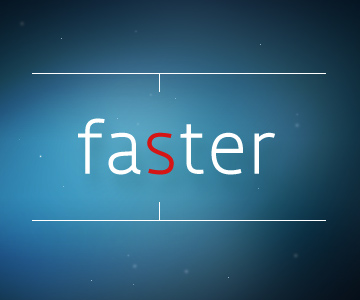
There’s a new app in the works that claims to enable you to read entire novels in less than the time it takes to watch a feature-length movie.
Last week, an article from Elite Daily began making the rounds on social media sites. The article introduces the app, called Spritz, and its “Optimal Recognition Point” (ORP) technology, and even lets you try it out. Hundreds of people shared it, including dozens my own Facebook friends, and to a person, each post I read hailed this new app as “amazing” and “miracle” and “game-changer,” etc. etc.
I’ll be the first to admit, I’m a very slow reader, so I’d be the first in line to latch onto any new technology that can help. But I tried the samples, and to be honest, it’s not working for me. Let me explain…
The technology works by flashing the individual words of any text, one at a time, consecutively on the screen. One letter of each word, just to the left of center, is colored red, and each red letter appears in the same part of the screen. The idea is that red letter is the Optimal Recognition Point where our brains see and decipher words. By flashing all the words in the same point we can read them faster.
But reading words quickly isn’t the problem for me. My problem is a near-obsessive focus on comprehension. Throughout grade school and college, I consistently scored higher than my classes on reading comprehension. But I scored lowest in my classes on overall reading tests, because I could never read fast enough to actually finish the tests. I got all the questions I answered correct, but I only ever answered a third of the questions.
It took me years to figure out but the reason for this odd dichotomy, but over time I realized I was reading the same sentences, or groups of sentences, or even paragraphs, over and over again. My mind won’t allow me to move on until I’ve fully grasped every ounce of meaning out of what I’ve already read. Of course that makes skimming all but impossible for me.
That need doesn’t go away with this new technology. With the samples presented on Elite Daily’s article, I had to watch each one cycle through several times before I really got it. Those samples are in repeating GIF format; I’m sure the app is more interactive. But even still, I doubt I’ll be saving much time if I still have to go back and repeat sequences of words.
I may be unusual, but I doubt I’m the only one. Then again, let’s play devil’s advocate. Let’s say I do save time, even if slightly. Is that slight time-saver worth the rest of what’s lost?
One of the nice things about a book is the layout. It’s very easy to go back and forth, re-read things you missed, check out how many pages you have until the next chapter break or other marker. Or maybe you’re at a passage that specifically references something earlier in the book, and you want a quick refresher on that previous section. And what about images, font changes, paragraph breaks and other variances in layout?
These are the things that make reading comfortable and enjoyable. Ultimately with a book, the reader has a certain amount of control in how the story is accessed. With an app like this, I can’t imagine how you wouldn’t lose a bit that control. Perhaps it might help some people with academic article and the like. But even how would you go back and reference important passages of make notes.
This actually is a good piece of technology. The science behind it is impressive, and I’m sure there are numerous educational and recreational applications for it. But it’s definitely not for everyone. So maybe let’s back off on the “game-changer” hyperbole a little.
GrabBag – Marvel, DC Nab Same Release Date; also, Potential Star Wars Casting

Another week, another GrabBag full of screen-related flotsam. Let’s get right to it, shall we?
- Famous People in Fiction is a 2-part series of pictures comparing historical figures to their more well-known movie incarnations. Something about that title doesn’t seem exactly right to me, but no matter. It’s fun to see all various actors that played the same roles lined up side-by-side. Part 1. Part 2.
- It’s a long way off but apparently DC and Marvel are battling over my 35th birthday (May 6, 2016) for major tent-pole film releases. Marvel has held that date for a while for an as-yet-unnamed film (probably Captain America 3). Meanwhile DC just pushed the new Superman/Batman back to that very same date. There’s still plenty of time for one of the studios to back down, but if neither does it may be an interesting experiment to challenge the old standard “one movie per demographic per weekend” model. That, and I’m likely to have an awesome birthday weekend!
- Speaking of tent-pole blockbusters, Variety gets a look at some of the actors being considered for the new Star Wars movie.
- This may be the nerdiest of nerdy Easter egg finds: Apparently Gandalf’s sword “Glamdring” is hidden in the Iron Throne from Game of Thrones. How many frames did that redditor pour over before he discovered this?
- The theater projection instructions for Wes Anderson’s The Grand Budapest Hotel are a fun read. (Click the image to see a full-screen version. Sorry about the blurry quality.)

- And finally, T Bone Burnett’s music for True Detective was truly inspired. Listen to the song from the end of the finale …
That’s all for this week. Tune in next Friday for a new GrabBag!
Review – True Detective, Season 1 (HBO)

If you haven’t seen True Detective yet, you owe it to yourself to address that. Don’t have HBO? Whatever. Find a friend with an HBOGO account. Find a torrent. Sign up for one of those cable promos they’re always offering and then cancel it when you’re done. I don’t care; just do what you have to.
I’m serious, I’ll wait…
OK, if you STILL haven’t watched it, I’ll keep this spoiler-free. But just know that there’s nothing I can say that will convince you more than just watching the first episode. This show gets its hooks in you quick and never lets go.
Rust Cohle and Martin Hart are cops on a 17-year quest to catch a serial killer in southern Louisiana. That’s about all you need to know about the plot going in. I don’t want to spoil the wonderful way it spools out through the 8 episodes. It’s Matthew McConaughey and Woody Harrelson’s instantly iconic characters that draw you in.
Rust is the ultimate eccentric skeptic genius. There are shades of Spock, Locke*, and Sherlock**, but that doesn’t even begin to describe him. Ultimately he’s all McConaughey – another knockout performance in his recent “McConnaissance” win streak. This may have even influenced his recent Oscar win; several episodes aired during the voting period. Even if it didn’t, the last scene of the final episode proves how much he deserves that trophy. Harrelson, meanwhile, has been having his own “Harrelssance” of sorts. (Check out most of his work since 2009’s The Messenger.) In less deft hands, Hart could be a thankless role: the straight man to counter all the crazy. But Woody reveals a man in many ways as damaged and destructive as Rust.
As the title suggests, classic tropes of true crime and murder mystery figure heavily into the narrative. But the genre is a structure. It sets the stage for a masterful script that will surely inspire not just filmmakers and storytellers, but modern day philosophers for a long time to come. As fantastic as the actors are (and all the actors are fantastic, not just the leads), they have the benefit of expertly constructed characters to start with. The dialogue, though often hard to understand (watch with subtitles if you can), is stunningly crafted and infinitely quotable.
The technical crafts are top form as well. The cinematography is gorgeous. The soundtrack by T Bone Burnett is haunting. And from Cohle’s sparse apartment (complete with an eyeball-sized mirror) and surprisingly arranged storage unit, to the house of a demented hoarder and an overgrown labyrinthine fortress (of sorts), the set design is truly inspired.
But the real genius is that, while it transcends its genre trappings, this show never becomes so arty that it loses sight of what makes that genre so enjoyable. As dark as it gets – and make no mistake, it gets pitch black at times – it never loses that feels of excitement and anticipation and, dare I say it, yes even fun.
As I write this review it occurs to me that most of it could be used to describe another groundbreaking TV show about a murder mystery from almost 25 years ago. Actually they don’t feel all that similar. True Detective eschews the soapy melodrama that Twin Peaks revels in, and ultimately I think the newer show is a bit more accessible. But lined up side by side, there are surprising similarities.
Then again, maybe it’s simpler than that. As Rust Cohle explains, “It’s just one story, the oldest, light versus dark.”
_____
*Lost (ABC)
*Sherlock (BBC)
Review – The Monuments Men
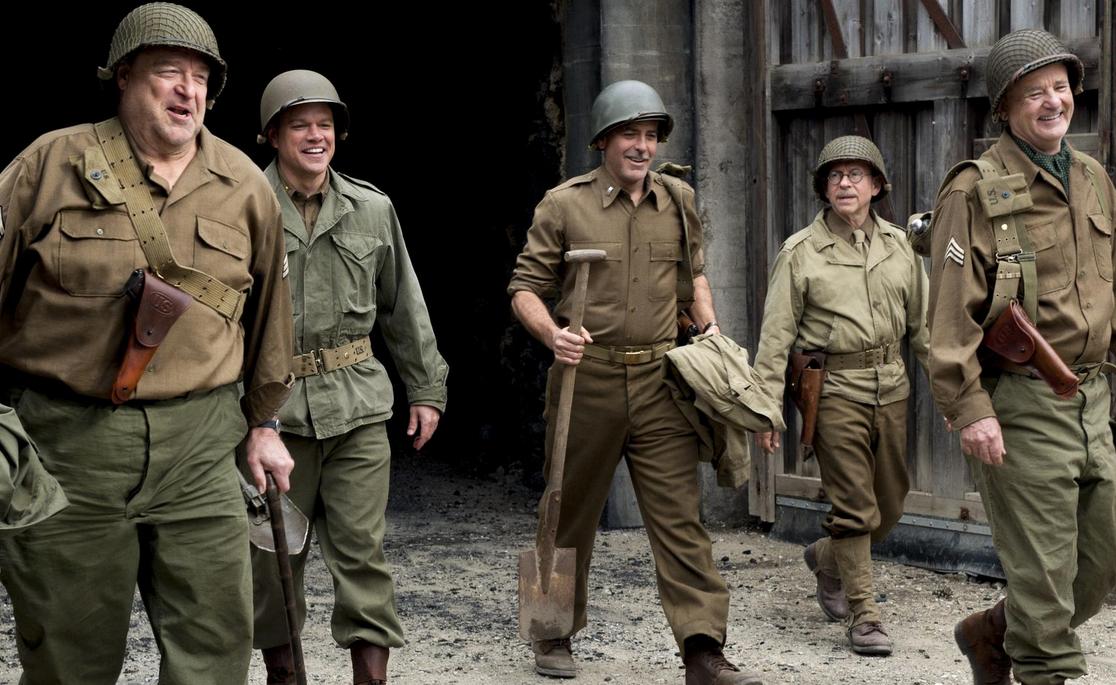
The Monuments Men is a perfectly good movie. It’s entertaining, fast-paced, well-acted, and smartly-constructed. It may not have much deeper meaning than what it strives for, but it accomplishes its mission with aplomb. It tells the true story of a small group of artists from various fields, all a little past their prime, recruited into the army in the waning days of WW2 to rescue priceless antiquities from being stolen or destroyed by Hitler’s forces.
The mood is kept generally light, it’s nice to see a war-comedy that strikes a good balance between the gravity of the setting and outright silliness. It’s neither Hogan’s Heroes, nor Saving Private Ryan, nor Life Is Beautiful. The large all-star cast in humorous action or planning scenes evokes a sort of Ocean’s 11-in-fatigues feel. Writer-director-star George Clooney and his co-writer Grant Heslov’s script has a clever device for handling what could be an unwieldy group. The characters are paired off for most of the movie – Bill Murray & Bob Balaban, John Goodman & Jean Dujardin, Matt Damon & Cate Blanchette – with the structure that works like a collection of funny vignettes moving back and forth between each pair.
The film was originally scheduled to be released last December, where it’s pedigree alone had already drummed up a considerable amount of awards-season talk. The producers, preferring the film to be cast in a more populist light, made the enlightened decision to push it back to February, thus avoiding any perceived “Oscar-snobbery.”
This was a great decision. It doubtless could have done quite well with awards. It’s a very finely crafted piece of filmmaking, with lots of talent both on and off screen. In fact, it likely could have made a major play for the top prize, maybe even won. Was it as good as those that did? Not even close. But it’s precisely the kind of well-made feel-good movie that no one can really dislike that so often wins awards. (Make no mistake: this year’s close race between two cutting-edge modern classics was a fluke.)
So pulling it out of the race and marketing it to the public instead of the campaigners was a great decision. The race was left to many superior players, and perhaps even more importantly, the usual February doldrums in the theaters – a time of year now famous for releasing the very worst movies – got a break with a decent piece of entertainment that’s worth the cost of admission.
GrabBag – The Twitter Conference Call
The Oscars are over. They’ve been analyzed, re-analyzed, interpreted, and meme-ified. It’s time for a final wave goodbye in our rearview mirror. Today’s GrabBag has just a few last Oscar-related videos, and then moves on. What will we do with our time now?
- The Impression Guys’ Academy Awards Special. Damn these guys are good!
- Here’s a montage of every Academy Award Best Picture winner since Wings.
- Apparently Captain Phillips’ Barkhad Abdi is broke. Here’s hoping his Oscar nomination (and BAFTA win) means more amazing roles to change that.
- And of course, it seems I can’t have a GrabBag lately without another version of “Let It Go.” This time Idina Menzel joins Jimmy Fallon and The Roots on kids’ classroom instruments for a seriously awesome rendition.
- Moving on… Indiewire just released the first still from the new film Life, starring Dane DeHaan as James Dean and Robert Pattinson as photographer Dennis Stock. (Dean DeHaan? James Dane? No?)

- Nicole Kidman plays actress-turned-Princess Grace Kelly in the new trailer for Grace of Monaco.
- I’ll be the first to admit, I’m not very active on Twitter. I just haven’t found a lot of uses for it, personally, aside from sharing my blog posts. But it does have its purposes…


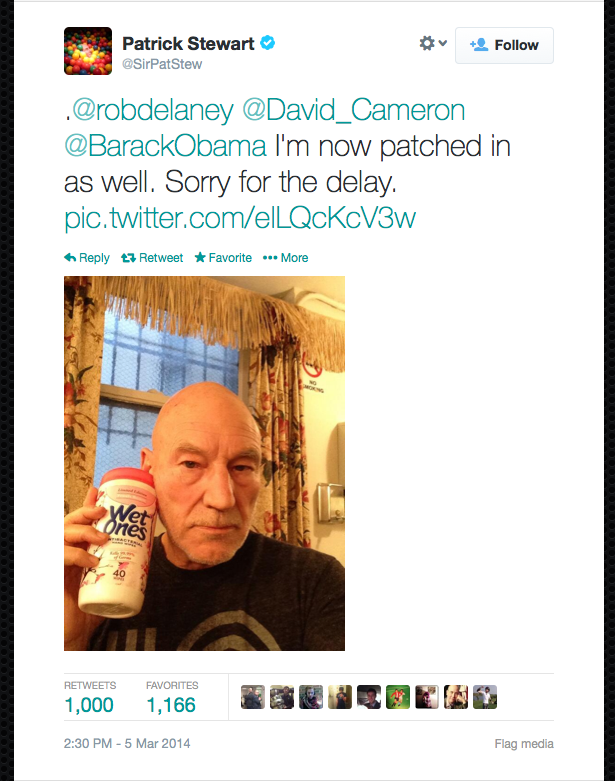
- Of course it didn’t end there. Mashable found several more people on the conference call.
- Finally… It’s not at all “screen” related, but my beautiful fiancé defends her PhD dissertation this afternoon, and by tonight it’ll be official. Everybody wish her luck!!!

That’s it for today. Remember to join us every Friday for more GrabBag goodness!
Who is True Detective’s “Yellow King?”
The 8th and final episode of True Detective airs this Sunday on HBO. I’ll save my review until it’s over, except to say this: If you haven’t seen it yet, stop what you’re doing right now and go watch it.
If you’re caught up with the show so far, you’ll find this Yellow King Theory quite… insightful. I won’t give away the video, but I can tell you it does NOT reveal any potential spoilers for the show.
Also…
If you have been struggling to understand the show’s dialogue (I use subtitles when I can), Community‘s Joel McHale and Jim Rash (Jeff and the Dean) are here to help. Ok, not really.
Review – The LEGO Movie

A movie based on a line of toys has to be the most thinly veiled marketing ploy, right? Its very existence screams “sell more toys.” When money is the focus, quality storytelling often takes a backseat. Just look at G.I.Joe or Battleship or the Transformers movies. The latter franchise has been enormously lucrative, and to that end The LEGO Movie sounds like the biggest golden goose ever. Its huge cast of little plastic figurines includes both DC and Marvel superheros, Lord of the Rings, Harry Potter, Star Wars, and even basketball stars. The marketing possibilities are endless.
But what if… and bear with me here… just what if… you mixed alllll that stuff with solid, skilled storytelling, a positive message for kids, genuine emotions, and real heart? How would all that turn out? I’ll tell you in the words of the film’s catchy opening number: “Everything is awesome!”
There is so much right with this movie that could so easily have been oh so wrong. That song is a perfect example, so let’s start there. The track by the talented Tegan and Sara (with help from The Lonely Island) is instantly catchy. It’s also the most generic pop song you could imagine, but it turns out that’s the whole point. It was written that way on purpose, and a later plot point turns on that very fact.
The comedy seems to be built around the kind of quick throw away jokes and pop-culture references that have become so popular in recent years. But like the trick with the song, very little is actually thrown away. Everything comes back, grows, becomes important, either to the plot or to the emotional depth of the narrative. Nothing is wasted.
Green Lantern (Jonah Hill) is on screen for at most a total of 60 seconds – barely even a cameo – yet his relationship with the equally minor Superman feels more genuine than anything on display in those other movies I mentioned in my first paragraph. BadCop (Liam Neeson) feels very gimmicky in the beginning of the movie, and is nearly heartbreaking by the end. And Benny (Charlie Day) – otherwise known as “80’s-Something Space Guy” – was my instant favorite, since I grew up with those sets. But as the movie continued, it was his determined excitement in the face of all the newer and cooler LEGOs that I found most touching.
There’s an unexpected turn in the 3rd act (I won’t give too much away, but if you’ve seen it you know what I’m talking about) that could easily have been poorly executed and thrown the whole thing into a tailspin. But like everything else, the filmmakers more than pull it off. And at the risk of revealing a magician’s secrets, I’m going to tell you how they do it:
The heart of this movie is the idea of creativity. It’s a powerful theme, and it’s infused throughout every single frame of the film. Every detail works toward a single message, a soul of boundless, limitless invention that cries out to young and old alike: “Never stop creating.”
 The Screen Life